Customers hate waiting for hot water and they usually blame the water heater first. You know the heater is fine, but explaining “thermal lag” to a frustrated homeowner is a losing battle. This guide covers the real reasons for a long hot water wait time and how to fix it for your clients.
Standard Times for Hot Water Delivery
Most homeowners think hot water should appear the second they flip the handle. In a perfect world, the EPA suggests that a fixture should deliver hot water within seconds. They generally want to see less than one cup of water wasted before the temperature hits 100 degrees. For a solo plumber, you know that almost no house in America actually hits that mark without help.
A normal wait time for a house with a standard tank is about 30 seconds to one minute. If the run is over 50 feet, that time can easily double. Customers often think their heater is dying when the real issue is just the distance the water has to travel. If it takes longer than two minutes, you are looking at a system design flaw or a mechanical failure.
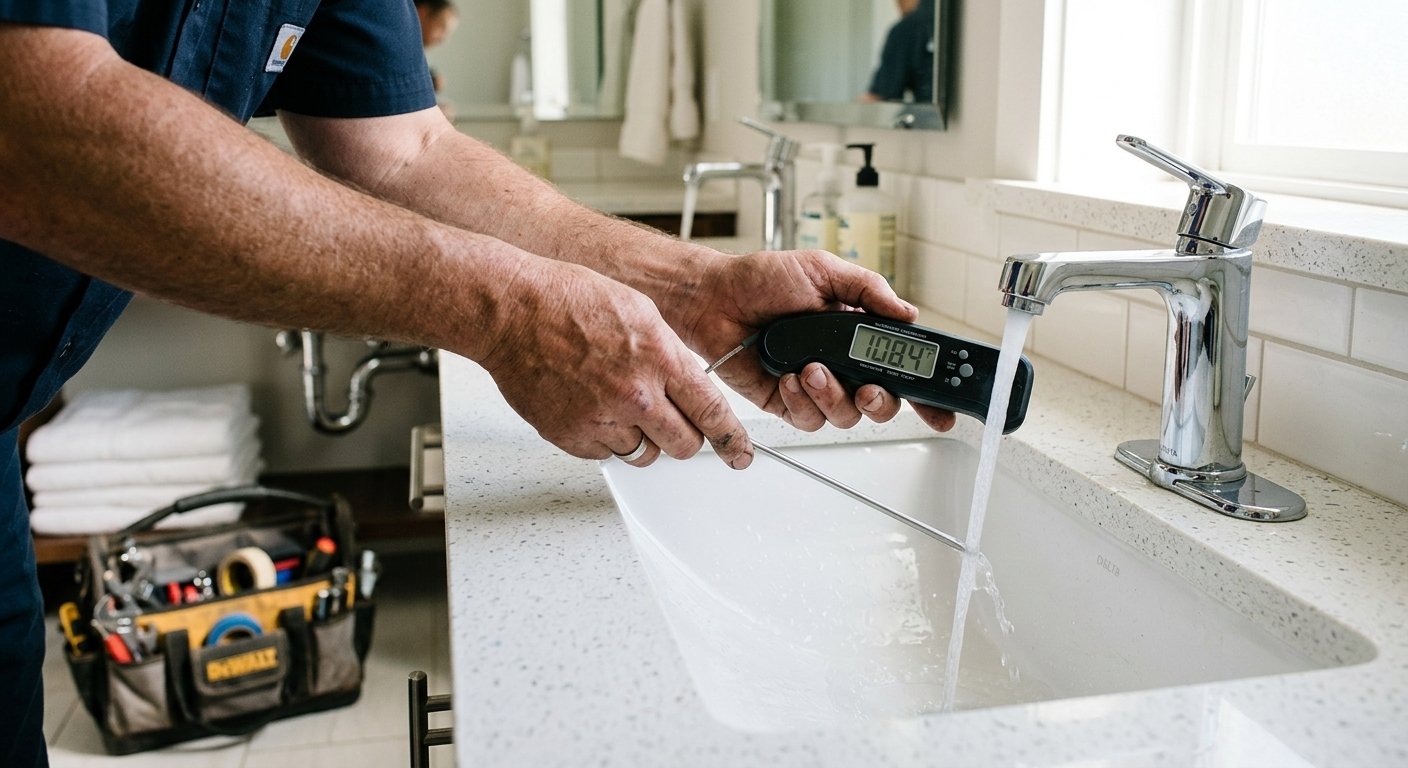
It is helpful to carry a stopwatch and a thermometer on your truck for these calls. Show the customer the actual numbers instead of just guessing. If the water coming out of the heater is 120 degrees but the tap stays cold for three minutes, the heater is doing its job. You need to show them that the “slug” of cold water sitting in the pipes has to move out of the way first.
How Pipe Size Changes Hot Water Wait Time
The diameter of the pipe is the biggest factor in how long a customer waits. Many older homes use 3/4-inch copper or PEX for the main trunk and even the branches. While 3/4-inch pipe moves a lot of volume, it also holds a lot of cold water. That cold water has to be pushed out completely before the hot water from the tank can reach the faucet.
A 3/4-inch pipe holds roughly double the water of a 1/2-inch pipe. If you have a long run to a master bathroom, that extra volume adds up to a massive delay. For example, 50 feet of 3/4-inch pipe holds about 1.5 gallons of water. If the faucet has a low-flow aerator running at 1.5 gallons per minute, the customer waits a full sixty seconds for heat.
When you are doing a repipe or a new build, try to keep the 3/4-inch pipe for the main trunk only. Use 1/2-inch or even 3/8-inch lines for the last few feet to the fixture. This reduces the “dead volume” in the line. Smaller pipes mean a shorter hot water wait time because there is less cold water to move.
The Impact of Pipe Material and Insulation
The material of the pipe changes how fast the water feels hot once it arrives. Copper is a heat sink, meaning it sucks the heat out of the water as it passes through. In the winter, a cold copper pipe will cool down the first few gallons of hot water. The customer might feel “lukewarm” water for a while before it finally gets truly hot.
PEX and CPVC are better at holding heat than copper. They do not steal as much energy from the water, so the temperature stays more consistent. However, the material does not change the fact that the cold water in the line must be displaced. It only changes how much the water cools down during the trip.
Pipe insulation is a smart move, but it does not work the way most customers think. Insulation does not make the water get there faster on the first run of the morning. It keeps the water in the pipe warm between uses. If the customer uses the sink every 30 minutes, insulation might keep that water hot enough that they do not have to wait at all.
Calculating the Volume of Water in the Line
You can look like a pro by doing the math right in front of the customer. To figure out the wait time, you need to know the pipe volume and the flow rate of the faucet. Most bathroom faucets today are restricted to 1.5 or 1.2 gallons per minute (GPM). If the pipe holds one gallon of water, and the faucet flows at 1 GPM, the wait is exactly 60 seconds.
Here is a quick reference for water volume per 100 feet of pipe:
- 1/2-inch Copper (Type L): 1.2 gallons
- 3/4-inch Copper (Type L): 2.5 gallons
- 1/2-inch PEX: 0.9 gallons
- 3/4-inch PEX: 1.9 gallons
Take the length of the run and multiply it by these numbers. Then divide by the GPM of the fixture. This gives you the theoretical minimum hot water wait time. If the actual wait time is much longer than your math says, you know there is a secondary issue like a cross-connection or a broken dip tube.
Fixing Long Wait Times with Recirculation Pumps
The most common fix for a long hot water wait time is a recirculation pump. These pumps keep hot water moving through the pipes so it is always “at the ready” near the fixture. There are two main types of systems you can install. The first is a dedicated return line, which is great for new construction but a pain for retrofits.
For existing homes, a bypass valve system is the easiest choice. You install the pump at the water heater and a small “comfort valve” under the sink furthest from the heater. This valve allows hot water to bleed into the cold water line until it reaches a certain temperature. It uses the cold water line as a temporary return path.
Be sure to explain the trade-off to the customer. Their cold water might be slightly warm for the first few seconds because of the bypass. Also, recommend a pump with a timer or a motion sensor. Running a pump 24/7 wastes energy and can cause premature pinhole leaks in copper pipes due to erosion. It is like a highway—too much traffic for too long wears out the road.
Point of Use Heaters as a Targeted Solution
Sometimes a recirculation pump is not the right fit. If a customer has one isolated sink in a guest house or a far corner of the home, a small electric point-of-use heater is better. These are usually 2.5-gallon to 7-gallon tanks that sit right inside the vanity cabinet. They plug into a standard 120V outlet and provide instant heat.
The main benefit here is that there is zero wait time. The hot water only has to travel two feet of supply line. This also saves a lot of water because the customer is not dumping two gallons down the drain while they wait. It is a high-value upsell for kitchen sinks or master baths where the wait is driving the homeowner crazy.
Before you install one, check the electrical situation. These small tanks usually pull about 12 to 15 amps. If the bathroom circuit is already loaded with a hair dryer and a space heater, you will trip the breaker. Always advise the customer that they might need an electrician to run a dedicated circuit for the new heater.
Troubleshooting Mechanical Issues That Delay Heat
If the wait time is long even when the faucet is close to the heater, something is broken. A common culprit is a broken dip tube inside the water heater. The dip tube sends cold water to the bottom of the tank. If it breaks off at the top, cold water stays at the top and mixes with the hot water going out to the house.
Another issue is a cross-connection. This often happens in single-handle shower valves. If the balancing spool or the cartridge fails, cold water can “crossover” into the hot side. This dilutes the hot water and makes it feel like the heater is failing. You can test this by feeling the pipes at the water heater while a hot tap is running elsewhere.
Sediment buildup can also slow things down in older tanks. If the bottom of the tank is filled with six inches of calcium and lime, the burner has to heat through that rock before it touches the water. This does not necessarily increase the travel time, but it lowers the starting temperature of the water. Check with your local code authority on the best ways to flush these systems safely.
Explaining Delivery Delay to Your Customers
Teaching the customer is part of the job. Most people do not understand that the water in the pipe cools down to room temperature in about 15 minutes. Use a simple analogy. Tell them it is like a garden hose left out in the sun. If they want the cool water from the spigot, they have to push out the hot water that was sitting in the hose first.
When you offer a fix, give them options. Start with the “free” fix, which is just waiting. Then move to the middle-ground fix like a timer-based pump. End with the premium fix like a dedicated return line or point-of-use heaters. Let them decide how much their time and the wasted water are worth to them.
Most plumbers find that once a customer understands the “why,” they are much more willing to pay for the “how.” Do not just tell them “that’s just how it is.” Give them the numbers and the solutions. This builds trust and usually leads to a bigger ticket on a call that started as a simple complaint.
If you need help explaining these technical plumbing concepts to your customers, we have a tool for that. There is a specific pack of AI prompts designed for plumbers that helps you write clear emails, text estimates, and blog posts. It helps you take the technical knowledge in your head and turn it into simple words that homeowners understand. This makes it easier to sell upgrades like recirculation pumps without sounding like a salesman.
Frequently Asked Questions
Why does my hot water take so long in the morning?
During the night, the water in your pipes loses all its heat and drops to the temperature of your walls or crawlspace. When you turn the tap on at 6:00 AM, the heater has to push all that cold water out before the hot stuff arrives. This is the longest wait of the day because the pipes have had hours to cool down completely.
Does a tankless water heater provide instant hot water?
No, tankless heaters actually take a few seconds longer to start the flow of heat than a tank. The unit has to sense the flow and fire up the burner before it starts heating. You still have to wait for the water to travel through the pipes from the heater to the faucet. If you want instant heat, you still need a recirculation system or a point-of-use tank.
Will insulating my pipes make hot water arrive faster?
Insulation does not speed up the initial flow of hot water, but it keeps the water in the pipes warm for a longer time. If you use the faucet, wait 20 minutes, and use it again, the water will still be warm if the pipes are insulated. Without insulation, that water would be cold again, and you would have to start the wait over.
Can a faulty shower valve cause a hot water delay?
Yes, a worn-out shower cartridge can allow cold water to leak into the hot water stream. This is called a cross-connection. It makes the hot water feel lukewarm or take much longer to reach the desired temperature. If you have plenty of hot water at your kitchen sink but the shower stays cold, the shower valve is likely the problem.
How much water is wasted while waiting for it to get hot?
In an average home, you might waste one to three gallons of water every time you wait for a distant faucet to get hot. If a family of four does this several times a day, it can add up to thousands of gallons of wasted water per year. A recirculation pump can almost entirely eliminate this waste by keeping the water moving.
Is a recirculation pump expensive to run?
A standard recirculation pump uses about as much electricity as a 25-watt light bulb. If you leave it running 24/7, the bigger cost is the extra work your water heater has to do to keep that water hot. Using a timer or a motion sensor on the pump makes it very cheap to operate while still giving you hot water when you need it.